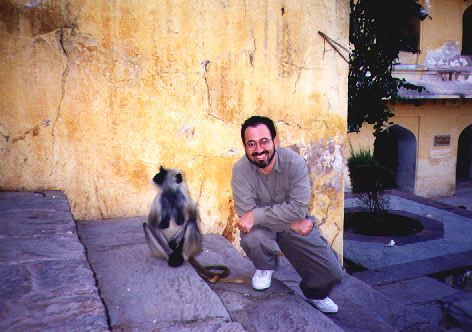
The fort is overrun with monkeys. They are totally unafraid of humans. This one barely even noticed my presence.
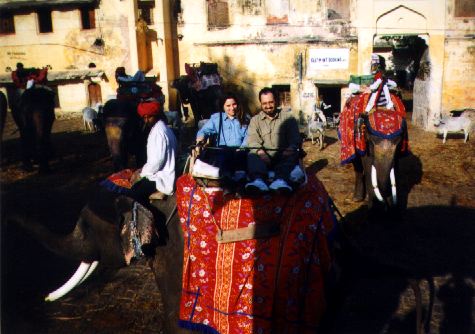
The fort is overrun with monkeys. They are totally unafraid of humans. This one barely even noticed my presence.
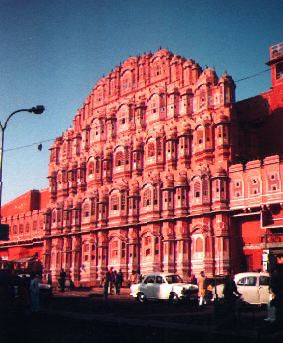
After lunch we toured the actual city of Jaipur beginning with the Hawa Mahal, pictured above. This is the most famous landmark in Jaipur. It is nicknamed
"The Palace of the Winds" because the cool westerly winds blow through it. It was built by Pratap Singh in 1799 and comprises five stories of semi-octagonal overhanging windows, with domes and spires. From the windows, the ladies of the court used to view the city below.
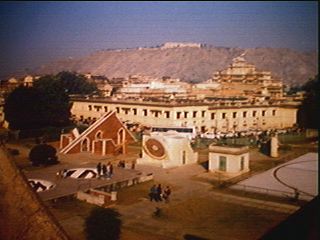
Next we visited the Jantar Mantar, a unique astronomical observatory constructed by Maharajah Jai Singh in 1718. This surreal collection of yellow sandstone sculptures is used to calculate the sun's declination, azimuth, or altitude and to determine the position of the stars and planets. There are two sundials, the larger of which measures time with 2-second accuracy. I took this picture from atop the larger sundial.
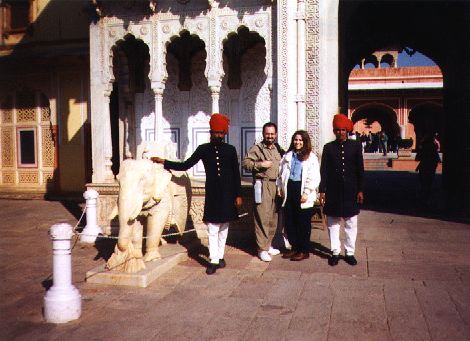
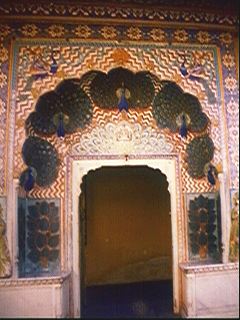
Near the Jantar Mantar is the City Palace, blending traditional Rajasthani and Mughal architecture. The palace had many lovely public spaces for dancing and walking as seen above. The other photograph shows a doorway containing images of peacocks, the national birds of India.
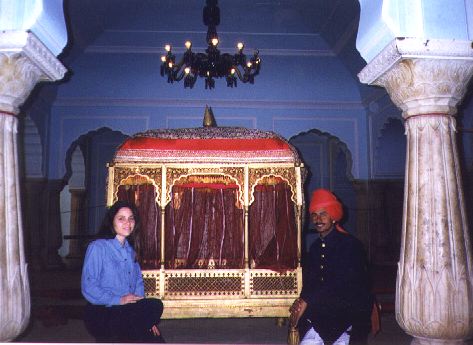
The City Palace also contained an impressive museum which included a large collection of elephant howdahs. These were used to carry rulers and other dignitaries on the backs of elephants. Kathleen liked the idea of traveling first class.
After this very long day of sightseeing we were quite tired. There is no rest for the weary, however. We had a prebooked dinner at an Indian carnival called Chowki Dhani. This was great fun!